
Ground-Mounted Solar In Manchester
Got a field, a bank or a dead corner of the yard doing nothing?
Frame-mounted solar arrays on farmland, brownfield plots and spare business land, wired back to the meter that pays your bills
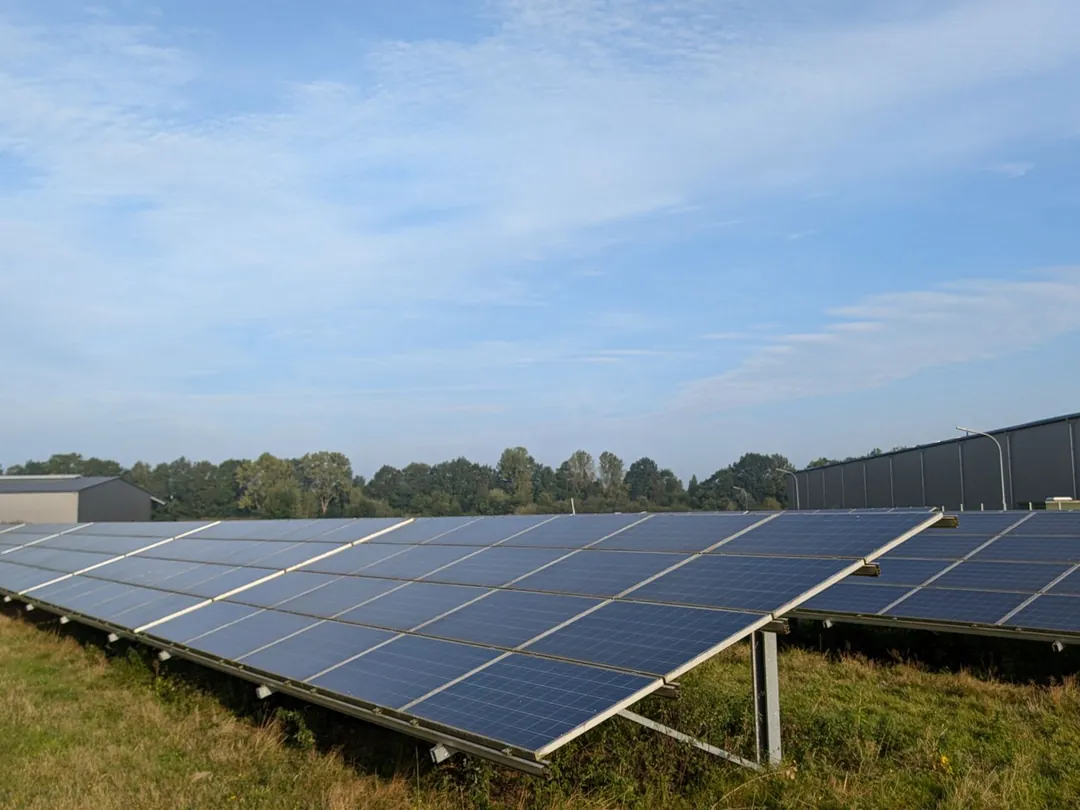
Ground-mounted solar in Manchester tends to start with a roof that can't take panels. Maybe it's asbestos-cement sheet on a 1960s shed, maybe it's a listed mill, maybe the roof is fine but already full. If you own land next to the building, the array can go there instead. Panels on steel frames, piled or screwed into the ground, set at the angle the sun actually wants rather than whatever pitch the roof happens to have. For a site in Trafford Park that difference is worth about a tenth more output per kWp than a shallow flat-roof layout. The trade-off is planning. Permitted development barely covers ground arrays on business land, so we treat a planning application as part of the job from day one, along with the cable route back to your intake and the G99 application to SP Electricity North West.
Tell us about the land
We reply within one working day to book a site visit.
What a ground array does that a roof can't
Ground mounting costs more in steel and cable than bolting rails to a sound roof. These are the reasons owners of farms, depots and yards in Greater Manchester still choose it.
01
The tilt is yours to pick
On a roof the angle comes with the building. On a frame we can set it close to the 40° PVGIS gives as optimal for south Manchester, facing almost due south. That's around 900 kWh per kWp a year at Trafford Park, against about 820 for panels laid at 10°. Same panels, more units, decided by a few lengths of steel.
02
No argument with the roof
Fibre-cement sheet, tired felt, a portal frame with no spare load capacity. Any of those can kill a rooftop scheme or add a re-roof to the bill. A ground array never touches the building, so the structural survey is about soil and wind, not purlins, and nobody has to walk across a fragile roof to fit it.
03
Room to go bigger
A roof caps the array at whatever fits inside the 1 m edge margin. Land rarely runs out that quickly. If your demand is high, or a heat pump, cold store or electric fleet is coming, a ground scheme can be sized to the load you'll have in five years rather than the roof you happen to have now.
04
Easy to reach, easy to look after
Every panel on a ground array is a few steps from a gravel track. Cleaning, thermal surveys and swapping a damaged module need no scaffold, no edge protection and no roof permit. Over a 25-year life, that cuts the fiddly part of the running cost and makes small faults far more likely to get fixed.
05
Farm diversification without losing the field
Panels set high enough on their frames leave grass underneath that sheep can still graze. Plenty of farms put arrays on the poorest pasture they have, then run the power to the dairy, the grain dryer or the farm shop. The land keeps an agricultural use and the electricity bill shrinks.
06
Tax treatment worth checking early
Solar panels count as special-rate plant for capital allowances, and the Annual Investment Allowance of £1 million covers most plant and machinery. In England, generating kit used on site is also exempt from business rates until March 2035. Your accountant should confirm how both apply to your company before you sign.
£0
Site survey and a review of your half-hourly data
kWh
Systems sized from your own meter readings
G99
Grid application drawn up and submitted for you
M17
Based on Trafford Wharf Road, Trafford Park
Ground arrays on Greater Manchester land
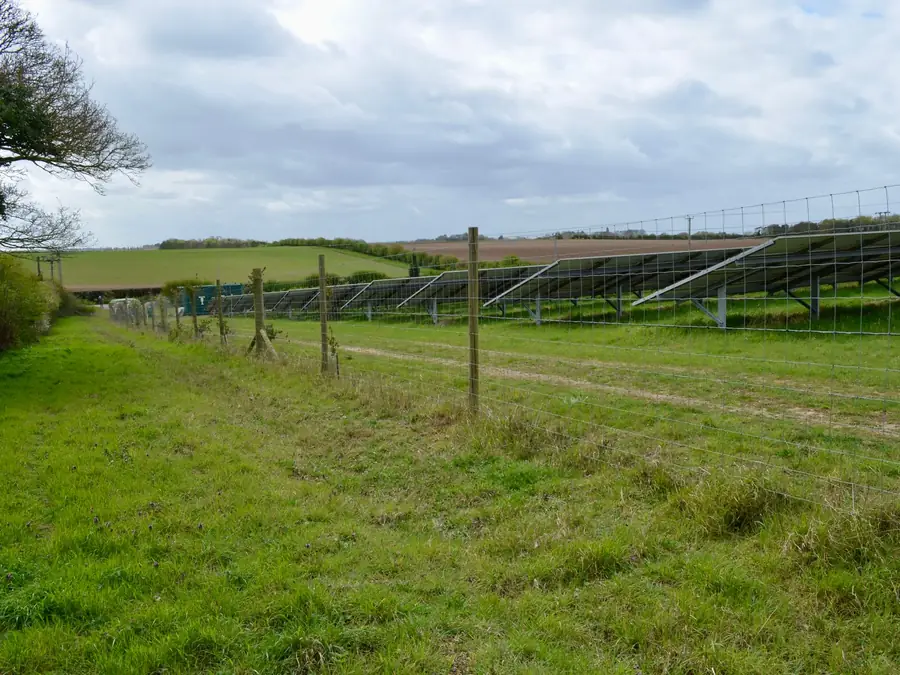
This city region has more spare ground than people expect, much of it on the western and north-western edge. Nomis business counts put around 115 farm businesses in Wigan borough and around 85 in Bolton, and a lot of that farmland sits on the mossland and old coalfield between Leigh, Tyldesley and Westhoughton. Add the yards, verges and paddocks around older industrial sites and there's no shortage of places a ground array could go.
Some of the best local examples are on land nobody wanted. Salford City Council switched on its first solar farm at Kenyon Way, Little Hulton, in March 2024: 2 MW, 3,774 ground-mounted panels on 3.8 hectares, producing over 2,000 MWh a year to offset the council's own bills. Over the border, an application went in during 2024 for a 10 MW scheme on 52 acres of the former Whitehead landfill at Astley Green, most of it in Wigan borough.
Neither of those is a typical commercial job; ours are usually a fraction of the size, sitting next to the building that uses the power. But they show the councils here will look seriously at ground solar on brownfield and restored land, which matters when your own application goes in to Wigan, Bolton, Salford or Trafford.
"Most of the ground-mount enquiries we get come from owners who were told their roof was the problem, and who then realised the paddock behind the shed wasn't earning anything either."
How we take a ground-mounted array from bare land to export meter
- 1
Walk the land and read the meter data
We look at the plot, the shading from hedges and trees, how wet the ground gets in winter and where the nearest intake is. Half-hourly consumption data tells us how much of the output your site will actually use.
- 2
Layout, yield and a planning view
You get a drawing showing rows, spacing, fencing and cable route, a PVGIS-based yield estimate and our honest read on how the council is likely to see it. Glint, screening and access are covered here, not discovered later.
- 3
Ground investigation and the G99 application
Pile or screw-foundation tests tell us what the soil will hold against wind uplift. In parallel the G99 goes to SP Electricity North West; over 50 kW that includes a G5 harmonic assessment, and at 150 kW or more Part 4 of the form must be complete at submission.
- 4
Planning application and pre-commencement conditions
The application goes in with drawings, a design statement and anything the planning officer asks for at pre-app stage. Once consent arrives we clear the conditions, which can include landscaping or ecology, before any steel goes in.
- 5
Frames, panels and the trench back
Foundations go in first, then the mounting structure, then panels and string cabling. The armoured cable to your switchroom is usually the longest job, especially where it crosses a yard or a farm track that must stay open.
- 6
Inverters, protection and testing
Inverters are mounted in a kiosk or on the building wall, the G99 protection settings are proved and the DC and AC sides are tested to BS 7671. Where an export limit is in the connection agreement, the limiting device is tested too.
- 7
Witnessing, metering and handover
Larger schemes may need the network operator to witness commissioning. We set up an export MPAN and half-hourly meter if you want SEG payments, then hand over the monitoring login, drawings, test results and a maintenance schedule.
Who answers for your Manchester installation, and for how long
There are two layers of cover on a commercial installation, and it pays to know which is which. The first is the installer's workmanship guarantee. It covers the way the system was put in: the fixings through your roof, the cable runs, the terminations, the protective devices and the commissioning settings. Its length and terms are written into the quotation, so you can read them before you sign rather than discover them afterwards.
The second layer belongs to the manufacturers. Panels normally carry a product warranty and a separate performance warranty, which promises a minimum output after a set number of years. Inverters and batteries have their own terms, often with cycle or throughput limits on storage. These vary by product, so every proposal names the exact models and attaches their warranty documents.
A guarantee is only as good as the install underneath it. That's why the structural check comes before the design is fixed, why every string is tested and recorded to BS 7671, and why the grid connection is commissioned to the settings SP Electricity North West has approved. If something we fitted fails because of how it was fitted, we come back and put it right.
In writing
Workmanship guarantee, set out in your quote
Per model
Manufacturer product and performance warranties
Test results, drawings, warranty certificates and the grid connection agreement are handed over in one pack on the last day.
What to look for in a ground-mounted solar installer
They know planning is the main event
Class K of the permitted development rules allows one stand-alone unit per non-domestic curtilage, no bigger than 9 m², no taller than 4 m and at least 5 m from the boundary. That's roughly four panels. Anyone who quotes a 100 kWp field array and talks about planning as a formality hasn't read it. The installer you want will budget time for a full application, talk to the planning officer early and design the layout with screening, glint and access in mind.
They test the ground before they price the steel
Foundations are where ground arrays go over budget. Made ground on old industrial land, soft peat on mossland and buried services on a farmyard all change the pile depth or rule out screws altogether. A sensible contractor will price a pull-out test or ground investigation before fixing the foundation cost, and will tell you plainly if the results change the scheme. A firm price given without one is a guess with a number on it.
They can explain the cable route
Power made in a field is no use until it reaches the meter. Ask exactly where the cable runs, how deep, what it crosses and how voltage drop over that length has been allowed for. On longer runs it can make sense to put the inverters near the array and run AC back. A good installer will have walked the route, spotted the drainage and the farm track, and costed the trenching rather than leaving it as a provisional sum.
Ground-mounted, rooftop or carport: how they differ
Many sites could take more than one of these. This is how the options tend to compare once you get past the brochure stage.
| Comparison point | Ground-mounted array | Rooftop array | Solar carport |
|---|---|---|---|
| Planning route | Full application for most commercial sizes | Usually permitted development (Class J), prior approval above 50 kW | Class OA with prior approval, if the conditions are met |
| Panel angle | Set to suit the sun, near 40° in Manchester | Fixed by the roof pitch, or shallow on flat roofs | Shallow, set by canopy design and headroom |
| Structural question | Soil, piles and wind uplift | Roof sheets, purlins and frame capacity | Foundations in a working car park |
| What it uses up | Land that could have another use | Nothing - the roof is already there | Nothing - the parking stays |
| Maintenance access | Walk up to it | Roof access, often fragile sheets | Ladder or MEWP over parked cars |
| Cable run to the meter | Can be long, trenched across the site | Short, inside the building | Moderate, often under tarmac |
Adding a battery to a field array
A ground array sized for summer will spill power at weekends and lunchtimes, especially on farms where demand peaks early in the morning and again at milking. Exporting that surplus earns something, but suppliers that mainly serve business customers aren't obliged to offer an export tariff at all, so check before counting on it.
A battery on the same connection holds the midday surplus and releases it into the 16:00 to 19:00 weekday red band, when network charges on Electricity North West's patch are at their steepest. It can also help where the G99 offer comes with an export limit.
How commercial battery storage works on a solar site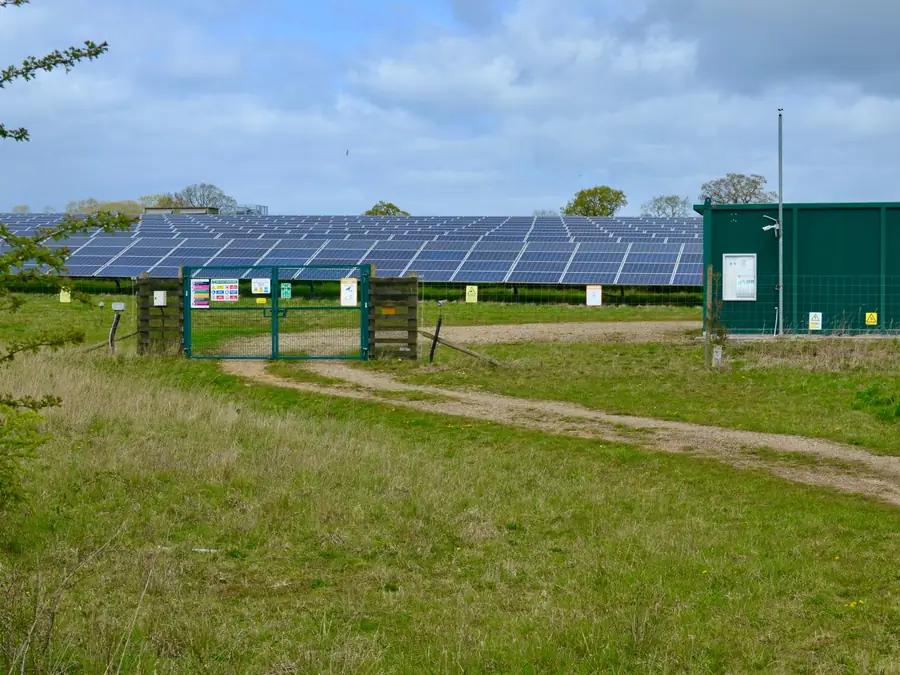
What decides the price of a ground array
Steel and groundworks are the swing items. Foundation type depends on the soil tests, the trench depends on how far the land is from your switchroom, and fencing and security depend on how exposed the plot is. Then there's planning: application fees, any ecology or landscape report the council wants, and the time it takes. We don't publish a per-kWp figure for ground arrays because these variables move it too much. You'll get a priced breakdown once the survey and ground tests are done.
Ground-mounted solar questions from Manchester landowners
Do I need planning permission for ground-mounted solar on business land?
Almost certainly. Permitted development (Class K) only covers one stand-alone unit of up to 9 m² per non-domestic curtilage, at least 5 m from the boundary and no more than 4 m high. Anything that would make a real dent in a commercial bill is far bigger, so it goes to the council as a full application. In our area that means Trafford, Salford, Manchester City, Bolton or Wigan Council, depending on where the land sits.
Can a ground array power a building on the other side of the yard?
Yes, as long as both sit behind the same meter, or you're prepared to arrange a private-wire supply. The array connects into your existing switchgear through an armoured cable, and the building uses the power before anything goes to the grid. Long runs need bigger cable to keep losses down, which is why we measure the route on the first visit rather than estimating it from a map.
Will sheep still be able to graze under the panels?
With the right frame height and fencing, usually yes. Sheep keep the grass down without damaging the structure, which saves on mowing around the rows. Cattle and horses are another matter, since they rub against frames and can damage cabling. If grazing is part of the plan, tell us at survey stage so the leading edge height and cable protection are designed around it from the start.
Is old industrial or landfill land suitable?
It can be very suitable, because it has few other uses. Salford's council-owned farm at Little Hulton and the application at the former Whitehead landfill near Astley Green both show the idea. The catch is the ground. Capped landfill often can't be pierced, so ballasted concrete foundations replace piles, and made ground may need investigation first. We'd want to see any existing site reports before quoting.
How long does the grid connection take?
The national standard gives a network operator 45 working days to issue a generation quotation where only low-voltage work is involved and 65 working days where high-voltage work is needed. Reinforcement, if the local network needs it, adds time beyond that. Most commercial ground arrays sit well under the 5 MW threshold now used for transmission impact assessments in most of England, which keeps them out of the slower queue.
Can I get paid for the electricity I export?
Possibly. The Smart Export Guarantee covers solar up to 5 MW and requires a half-hourly meter with an export MPAN. Large suppliers with 150,000 or more domestic customers must offer a tariff, but suppliers that mainly serve businesses don't have to. Some business suppliers do publish export rates, so it's worth shopping around. Over 5 MW, export is sold through commercial contracts instead.
Related: Rooftop commercial solar · Solar carports · Battery storage
What Manchester businesses say about us
We're a new name, so you won't find a wall of reviews here yet. We'd rather show you nothing than make some up.
For a project this size, reviews were never the best evidence anyway. Ask any installer you're considering for a reference site you can visit, a year or more of generation data from a system they fitted, and the grid connection paperwork from a past job. If they can't produce those, keep looking.
Land we survey for ground arrays around Greater Manchester
Find out whether your spare land can carry an array
Send us a location pin or a postcode, roughly how much ground you have and a year of electricity bills. We'll tell you whether a ground array makes sense before anyone talks about planning fees.