
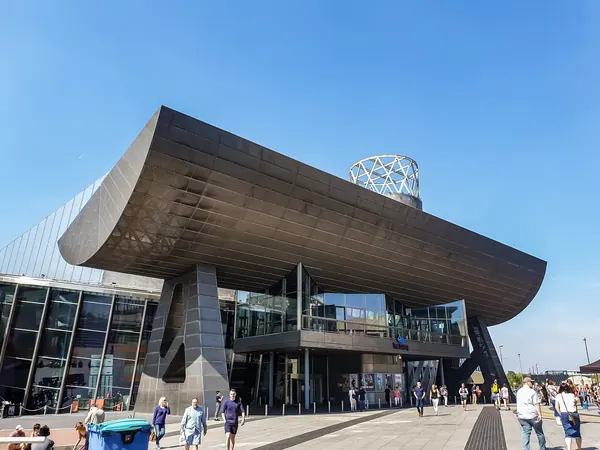
The Lowry
The steel-clad arts centre at the tip of Pier 8 on Salford Quays, opened in 2000, stages theatre and comedy and has galleries showing work by L.S. Lowry.
Learn more about The Lowry on Google MapsCommercial solar panels in Salford have to be designed for at least four quite different kinds of site. Out west, around Irlam, Cadishead and Northbank, the city is a run of big, low-pitched logistics and process buildings near the Ship Canal, many of them working nights as well as days. Barton and Weaste have a mix of older works and mid-sized trade units. At Salford Quays and MediaCityUK the buildings are offices and studios with a very different demand curve. We work across all of them from our base just over the canal in Trafford Park, but the western sheds are where we spend most of our survey time. Their roofs are large, their loads are heavy around the clock, and the question is rarely whether solar will be used. It is how much of the array's output you can keep, and whether a battery should carry some of it into the night shift.
We reply within one working day to book a site visit.
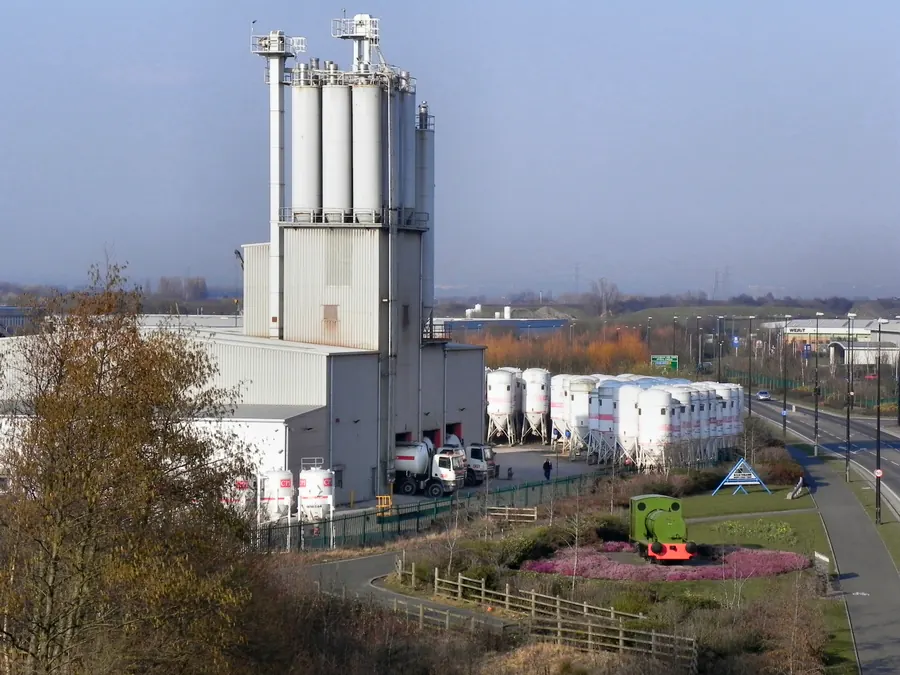
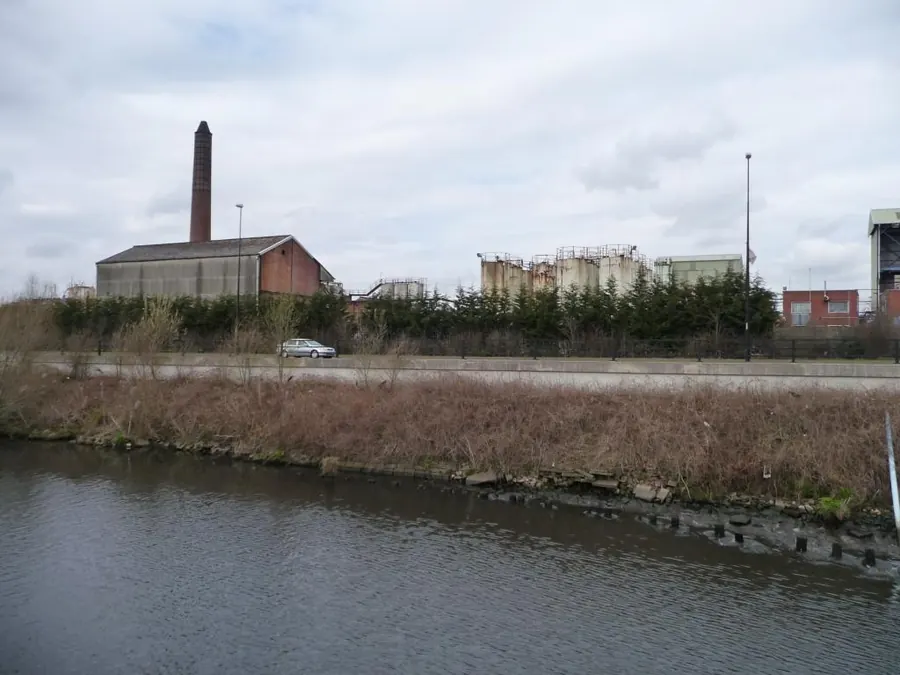
Irlam and Cadishead grew up on heavy industry. The CWS soap works opened in 1895, and the Partington Steel & Iron Company started its Irlam steelworks in 1910. Steelmaking had ended by 1979, and the land became Northbank Industrial Park, reached off Cadishead Way and Gilchrist Road. The canal-side brick buildings and chimneys you still see there sit next to modern clad sheds and process plant. For a solar designer that means roofs of very different ages within a few hundred metres, some needing a structural check and a close look at the sheeting before anything goes on them.
Further east, Port Salford is being developed as a tri-modal freight hub on a 339-acre site between Barton Bridge and Irlam, with rail-linked warehousing and container berths on the Ship Canal. Barton Hall Industrial Estate in Eccles, Weaste and Seedley carry smaller trade and light-industrial units. Salford City Council has already shown what local solar can do: its first solar farm, on Kenyon Way in Little Hulton, switched on in March 2024 with 3,774 ground-mounted panels and a 2 MW capacity, producing more than 2,000 MWh a year towards the council's own electricity bills.
£0
Site survey and a review of your half-hourly data
kWh
Systems sized from your own meter readings
G99
Grid application drawn up and submitted for you
M17
Based on Trafford Wharf Road, Trafford Park
For sites that run through the night, a battery lets you fit a bigger array than daytime load alone would justify, then use the surplus on the late and night shifts.
Learn more about battery storage in Salford →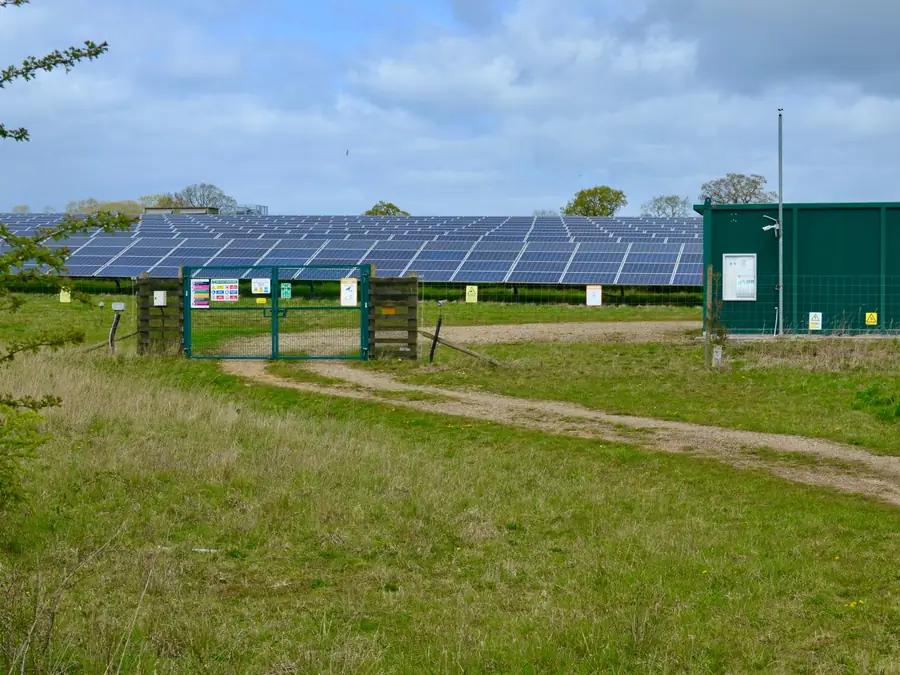
Spare land beside a works or depot on the western edge of the city can take a ground array, wired back to your own intake rather than the roof.
Learn more about ground-mounted solar in Salford →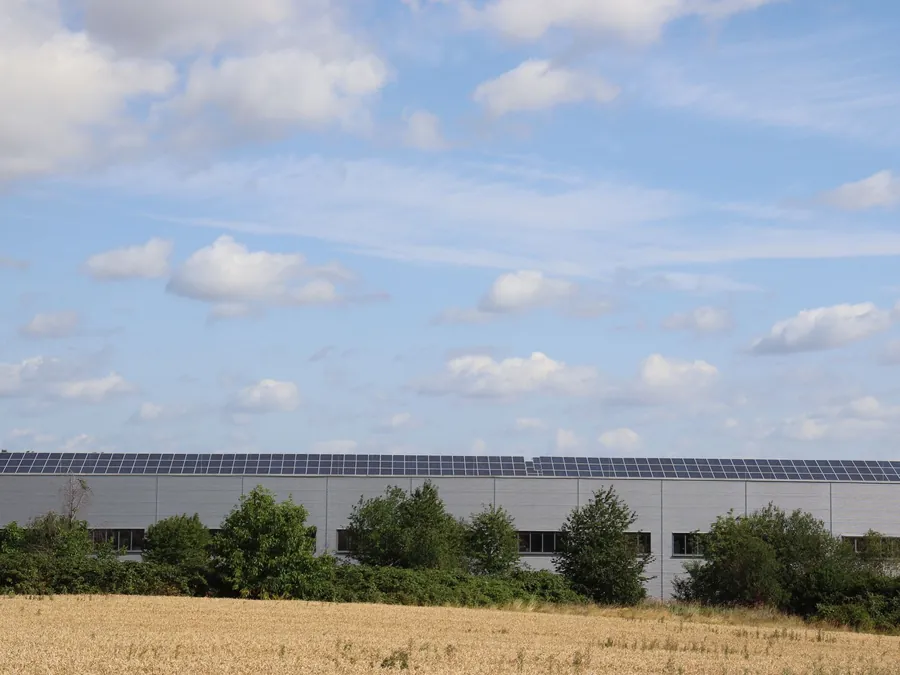
Rooftop PV for low-pitch logistics sheds, older brick works and Quays office blocks, laid out around your roof lights, plant and fire routes.
Learn more about commercial solar panels in Salford →A 24-hour warehouse and a daytime office need different arrays. These are the points that tend to decide the case in Salford.
A distribution shed near Port Salford or Northbank often has refrigeration, lighting, IT and battery charging for forklifts running at every hour. That steady base load means a well-sized array is used almost entirely on site, even on the brightest June afternoon, because the building never drops to zero.
Many of the newer western sheds have shallow pitched or near-flat roofs. An east-west layout fits more panels and spreads output across the morning and late afternoon. PVGIS puts an east-facing panel at a 10 degree tilt in this area at around 750 kWh per kWp a year, less than a south-facing one, but you get more kWp on the roof.
Port Salford, Northbank and Salford Quays are not in conservation areas. Rooftop arrays on non-domestic buildings normally go through permitted development, with a prior approval application to Salford City Council once a system goes over 50 kW.
At MediaCityUK and around the Quays, office demand rises through the morning with air conditioning and IT, then falls away from early evening. Solar matches that curve closely, though the roof area on a multi-storey block limits how big the array can be. We size for the roof you have and say plainly what share of your load it will cover.
Every kWh you use from your own roof avoids the import price, plus the Climate Change Levy, which is 0.801p per kWh from April 2026. Exported units earn only what a supplier chooses to offer under the Smart Export Guarantee or a commercial deal. On a site with a large base load, that gap is the main reason the payback works.
If your board wants to see solar working in Salford before signing off, the council's own 2 MW site at Little Hulton is a useful reference. It runs alongside the city's commitment to the Greater Manchester target of carbon neutrality by 2038.
"Most of the Salford sheds we're asked to look at keep their lights, chillers and dock doors working long after dark, which changes how much of the array's output they can use on the day."
There are two layers of cover on a commercial installation, and it pays to know which is which. The first is the installer's workmanship guarantee. It covers the way the system was put in: the fixings through your roof, the cable runs, the terminations, the protective devices and the commissioning settings. Its length and terms are written into the quotation, so you can read them before you sign rather than discover them afterwards.
The second layer belongs to the manufacturers. Panels normally carry a product warranty and a separate performance warranty, which promises a minimum output after a set number of years. Inverters and batteries have their own terms, often with cycle or throughput limits on storage. These vary by product, so every proposal names the exact models and attaches their warranty documents.
A guarantee is only as good as the install underneath it. That's why the structural check comes before the design is fixed, why every string is tested and recorded to BS 7671, and why the grid connection is commissioned to the settings SP Electricity North West has approved. If something we fitted fails because of how it was fitted, we come back and put it right.
In writing
Workmanship guarantee, set out in your quote
Per model
Manufacturer product and performance warranties
Test results, drawings, warranty certificates and the grid connection agreement are handed over in one pack on the last day.
We take a full year of half-hourly data and look at the night shift as carefully as the day. For round-the-clock sites, the overnight base load tells us how much solar the building will absorb without help.
Where a battery could change the answer, we price the array two ways: sized to daytime load alone, and sized to the roof with storage behind it. You see the payback for each before choosing.
Older buildings around Cadishead and Barton get a structural survey and sheeting check. We then submit the G99 application to SP Electricity North West, which covers every part of Salford.
On a 24-hour operation there is no quiet day for scaffolding. We phase the roof work by bay, keep exclusion zones away from live loading doors, and agree with your shift managers which areas are closed and when.
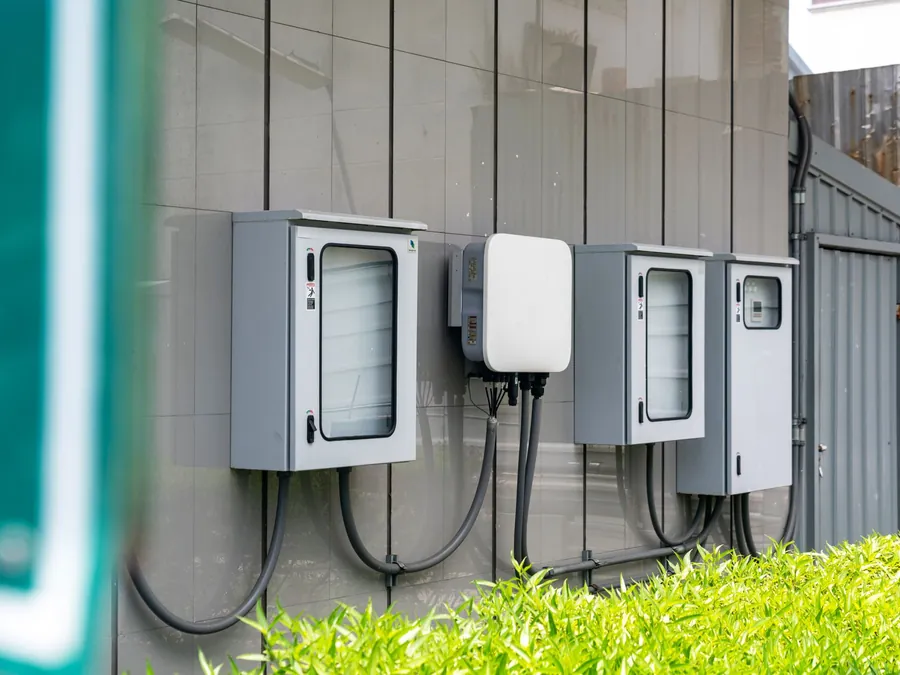
Rails are fixed to suit the sheet profile, panels go on in the layout we agreed, and the inverters are mounted where they are easy to isolate. Cable routes avoid fire doors and racking.
We test each string, check the protection settings required by the connection agreement, and run the system against live load through a full day before handover.
You get a monitoring portal and a handover pack. We also show you how generation lines up with each shift, which is the clearest way to judge whether storage would add value later.
The steel-clad arts centre at the tip of Pier 8 on Salford Quays, opened in 2000, stages theatre and comedy and has galleries showing work by L.S. Lowry.
Learn more about The Lowry on Google Maps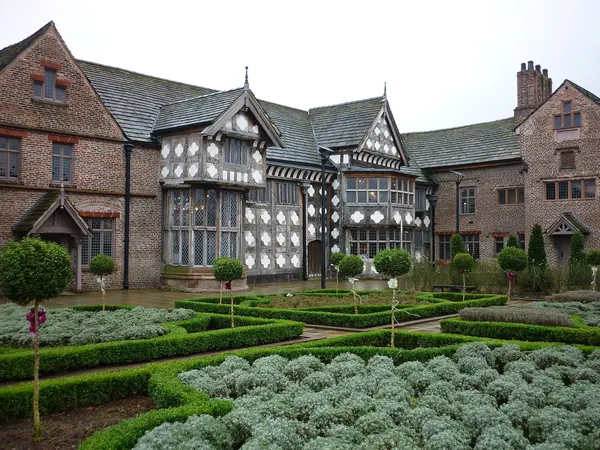
A Grade I listed Tudor manor house in Ordsall, first recorded in 1210, now a free museum with period rooms and restored formal gardens after a major restoration finished in 2011.
Learn more about Ordsall Hall on Google Maps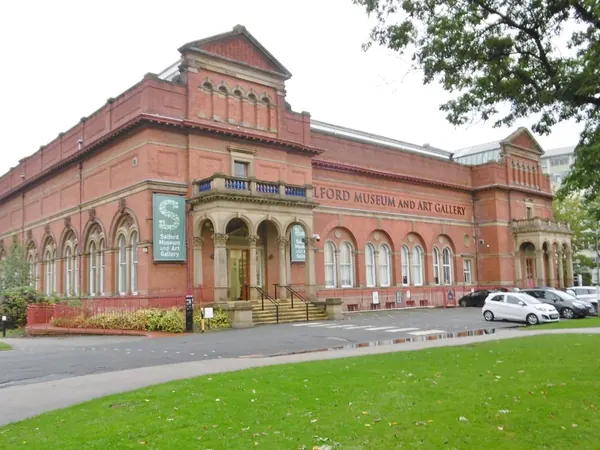
Set at the edge of Peel Park on The Crescent, this museum opened in 1850 and is best known for Lark Hill Place, a recreated Victorian street, alongside its Victorian art gallery.
Learn more about Salford Museum & Art Gallery on Google MapsWe're a new name, so you won't find a wall of reviews here yet. We'd rather show you nothing than make some up.
For a project this size, reviews were never the best evidence anyway. Ask any installer you're considering for a reference site you can visit, a year or more of generation data from a system they fitted, and the grid connection paperwork from a past job. If they can't produce those, keep looking.
For a Salford business the main cost drivers are roof size and condition, the distance between the array and your main switchgear, and any work SP Electricity North West needs on its side of the meter. Large western sheds benefit from scale, as per-kW prices usually fall as systems grow. Older works around Cadishead and Barton may need roof repairs first. For context, DESNZ's 2025/26 figures put non-domestic systems of 10 to 50 kW at a mean of about £1,167 per kW across Great Britain, including installation and grid connection. Storage, if you add it, is priced separately.
Salford City Council is the planning authority. Rooftop solar on a non-domestic building is usually permitted development under GPDO Part 14, Class J. Systems over 50 kW need prior approval from the council on design, appearance and glare, which it has 56 days to decide. Panels must stay at least 1 m from the roof edge and cannot go on a listed building. If your site is inside a conservation area, such as Barton-upon-Irwell around the swing aqueduct, check with the council before relying on permitted development.
Often more so than for a daytime business, because a site that never closes uses nearly everything the roof produces. The design question is how big to go. If the array exceeds your midday base load, a battery can carry the surplus into the evening and night shifts instead of exporting it.
Some older works buildings can, and some cannot without roof repairs or new sheeting. We start with a structural check and a look at what the roof is made of. Fibre-cement sheets are treated as fragile under HSE guidance, so they have to be identified before anyone works on the roof.
Yes, if you have it. A ground-mounted array of any useful size needs a full planning application, as permitted development only covers very small stand-alone units. It also needs a cable route back to your main intake, which we assess at survey.
From Irlam to the Quays, we can tell you in one visit whether your Salford site suits solar on its own or solar with storage, and what each would return.