
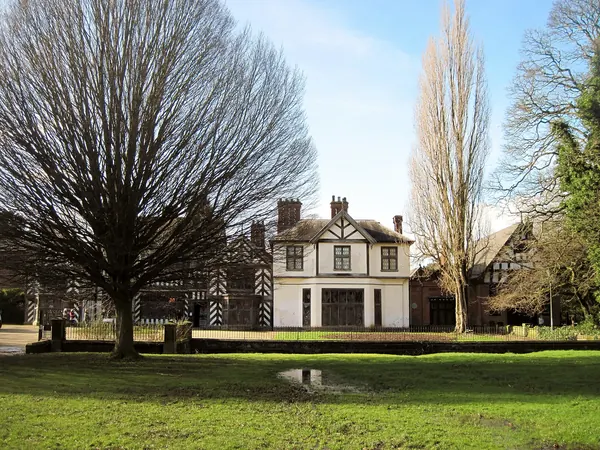
Wythenshawe Hall
A timber-framed Tudor hall built around 1540, badly damaged by arson in 2016 and reopened to visitors in 2022 after a long repair programme.
Learn more about Wythenshawe Hall on Google MapsBattery storage in Wythenshawe works differently from storage on a five-day factory. A distribution shed near the airport rarely has much surplus solar to store, because it consumes almost everything the roof makes. Where a battery earns its place is in two other jobs. One is the weekday red band, 16:00 to 19:00, when distribution charges peak and a busy cargo or logistics site is still loading. The other is capacity: as forklift fleets, electric vans and yard equipment move to battery power, charging demand can push a site towards its agreed kVA, and SP Electricity North West bills any excess for the whole billing period. A battery that discharges at the right moments keeps you below the line. We model the gain on your own half-hourly data, so the size reflects how your Wythenshawe site actually runs.

We reply within one working day to book a site visit.
For operations that never close, the value lies in timing and capacity rather than storing surplus generation.
01
Red-band DUoS charges for smaller aggregated business sites run at roughly six to ten times the amber rate. A logistics site that keeps loading trailers through the early evening pays them every weekday. Charging overnight in the green band and discharging between 16:00 and 19:00 moves that cost into the cheapest hours of the day.
02
Adding chargers for forklifts or delivery vans can take a site above its Maximum Import Capacity at busy times. A battery can supply the charging peak instead, avoiding a capacity increase that may need reinforcement and cannot easily be reversed, since MIC can only be reduced once every 12 months.
03
Dock levellers, chillers coming back on after a door has been open and charging banks all starting at shift change can create short, sharp peaks. Even one breach of your agreed capacity is charged across the whole billing period, so catching those spikes is often where the quickest return sits.
04
SP Electricity North West offers flexible connections to avoid reinforcement costs and timescales. Pairing a battery with an export limit or a managed import profile can make a connection offer workable where a firm capacity increase would mean waiting for network works.
05
Storage installed alongside on-site renewables, such as a roof or carport array, falls within the England business rates exemption until 31 March 2035. The legislation also mentions storage used with EV charge points, which is relevant for fleet charging, though how it applies to a given site is worth checking with your rating adviser.
06
A battery on a 24/7 site may cycle every day of the year. Lithium iron phosphate cells are widely used for this kind of duty, and datasheets give cycle-life ratings at a stated depth of discharge. We compare those ratings with the cycling your site will actually need, not with the headline figure.
£0
Site survey and a review of your half-hourly data
kWh
Systems sized from your own meter readings
G99
Grid application drawn up and submitted for you
M17
Based on Trafford Wharf Road, Trafford Park
The demand profile around Roundthorn, Sharston and the airport cargo area is unusual for Manchester. On round-the-clock sites base load stays high through the night, so a solar array rarely overproduces, and storing surplus is a minor part of the case. The part that matters is the shape of demand at shift change and in the early evening, when loading, chilling and charging can all peak together on a supply that may have been agreed years ago for a different use.
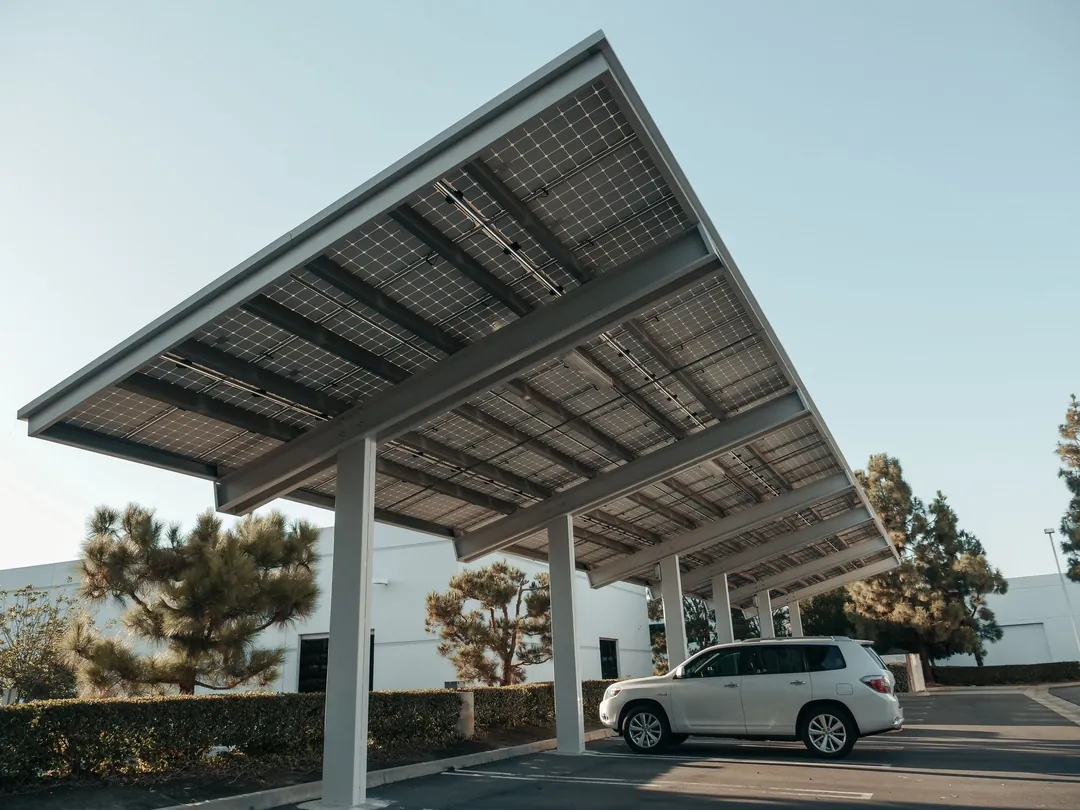
Space is usually less of a problem than on older estates. Many units have wide yards and car parks where an outdoor battery cabinet or container can meet separation distances and leave room for fire service access. A carport array over staff parking can feed that battery and the chargers beside it, giving a compact set-up that keeps all the new electrical load at one end of the site.
To see how a roof or carport array would sit with the battery, read our page on commercial solar panels in Wythenshawe, which covers glare near the airport and the planning route for each option.
"Most of the Wythenshawe battery enquiries we see start with a plan to electrify forklifts or delivery vans, not with a question about storing solar."
We analyse your half-hourly data, then add the charging load from any planned fleet electrification. That shows how close the site will come to its agreed capacity and which hours carry the most red-band cost, before any equipment is chosen.
The proposal sets out the battery's power and energy rating, when it charges, when it discharges and the threshold it holds demand below. If a flexible connection would work better than a capacity increase, we show both options side by side.
Batteries are treated as generation, so we apply to SP Electricity North West under G99. At the same time we fix the location and separation distances, and for larger systems we recommend contacting the fire and rescue service early, as planning guidance encourages.
Plinths, ducts and impact barriers go in while the site keeps working. We fence off a work area away from HGV routes and agree timings with your transport team so trenching across a yard does not hold up arrivals or departures.
The battery modules, inverter, protection equipment and site controller are installed, with metering on the incoming supply so the controller can see live demand. Chargers and any solar array are linked to the same controller so the whole system works as one.
Final connection to the main board is planned for a short, agreed window, often overnight. We test the G99 protection, prove two-way protective devices and confirm the battery holds demand below the set threshold under real conditions.
You receive documentation, emergency isolation procedures and monitoring access. As you add vehicles and chargers, we review the dispatch settings so the battery keeps pace with the new load instead of working to last year's profile.
There are two layers of cover on a commercial installation, and it pays to know which is which. The first is the installer's workmanship guarantee. It covers the way the system was put in: the fixings through your roof, the cable runs, the terminations, the protective devices and the commissioning settings. Its length and terms are written into the quotation, so you can read them before you sign rather than discover them afterwards.
The second layer belongs to the manufacturers. Panels normally carry a product warranty and a separate performance warranty, which promises a minimum output after a set number of years. Inverters and batteries have their own terms, often with cycle or throughput limits on storage. These vary by product, so every proposal names the exact models and attaches their warranty documents.
A guarantee is only as good as the install underneath it. That's why the structural check comes before the design is fixed, why every string is tested and recorded to BS 7671, and why the grid connection is commissioned to the settings SP Electricity North West has approved. If something we fitted fails because of how it was fitted, we come back and put it right.
In writing
Workmanship guarantee, set out in your quote
Per model
Manufacturer product and performance warranties
Test results, drawings, warranty certificates and the grid connection agreement are handed over in one pack on the last day.
For airport-belt businesses the choice is usually between paying for more grid capacity, accepting higher peak charges or installing storage. The table compares those routes for a site where demand never fully drops away.
| Comparison point | Solar only | Solar + battery | Battery on its own (tariff shifting) |
|---|---|---|---|
| Solar used on site | Only what the load takes at the time | Higher: surplus stored for later | No solar involved |
| Red-band (16:00-19:00) costs | Little effect, almost none in winter | Cut with stored solar or overnight charge | Cut with overnight green-band charge |
| kVA capacity charges | No reliable effect | Peaks can be shaved | Peaks can be shaved |
| DNO export limit | Surplus above the cap is lost | Surplus stored instead of clipped | Cap applies to battery discharge too |
| Backup in a power cut | None as standard | Only if designed for it | Only if designed for it |
| Planning and permissions | G99; roof usually permitted development | G99; roof PD plus a siting and fire review | G99; no PD class, so take planning advice |
We do not quote a standard price per kWh because there is no reliable published figure for commercial batteries. Instead, the cost is built from the specification and the site.
A battery sized only for today's red-band load is smaller than one sized for a future fleet of electric forklifts or vans. We show the cost of each stage, so you can decide whether to install for the full plan now or expand later.
Units at Roundthorn, Sharston and Airport City usually have more yard space than older city estates, which keeps siting simple. Where the only clear area is far from the main board or near busy HGV routes, longer cables and impact protection add cost.
Larger logistics sites often take their supply at high voltage with their own transformer. Connecting a battery on the HV side or the LV side changes the equipment, the protection settings and the G99 process, and each route is priced differently.
A battery that has to coordinate a roof array, a carport and a bank of chargers needs a more capable controller and more metering than a standalone unit. That costs more upfront but is what lets the system respond to the site's real demand.
In many cases, yes. If the problem is short charging peaks rather than continuous demand above your capacity, a battery can supply those peaks and keep the site below its agreed kVA. We test this against your half-hourly data and the planned charging load before recommending it.
The airport is mainly a consideration for solar panels because of glare, not for batteries. For storage the local factors are yard layout, distance from buildings, fire service access and keeping the unit clear of vehicle routes. Many airport-belt sites have enough space for an outdoor unit.
There is no permitted-development class for battery storage, so we seek planning advice from Manchester City Council and prepare an application if one is needed for an external unit. For systems of 1 MWh or more, planning guidance encourages contacting the fire and rescue service before applying.
Not unless it is designed for backup. Grid-connected batteries disconnect when the network fails. Backup operation needs extra switching to isolate the site and is priced separately. For sites with critical loads, we can design for it, but it is a separate decision from peak shaving.
It depends on the chemistry and how hard it is cycled. One published lithium iron phosphate datasheet rates its product at 6,000 cycles or more at 90% depth of discharge, with a 10-year warranty, but that is one datasheet, not an industry standard. We compare the warranty terms with your expected daily cycling before recommending a unit.
A timber-framed Tudor hall built around 1540, badly damaged by arson in 2016 and reopened to visitors in 2022 after a long repair programme.
Learn more about Wythenshawe Hall on Google Maps
The big public park around the hall, with open parkland, woodland, a statue of Oliver Cromwell, a community farm and a horticulture centre.
Learn more about Wythenshawe Park on Google Maps
A viewing park on the edge of Manchester Airport where you can watch aircraft take off and land, and tour Concorde G-BOAC, on display here since 2004.
Learn more about Runway Visitor Park on Google MapsWe're a new name, so you won't find a wall of reviews here yet. We'd rather show you nothing than make some up.
For a project this size, reviews were never the best evidence anyway. Ask any installer you're considering for a reference site you can visit, a year or more of generation data from a system they fitted, and the grid connection paperwork from a past job. If they can't produce those, keep looking.
Send us your meter data and your charging plans. We'll show how much capacity headroom and peak-charge saving storage could deliver, and when a bigger connection is the better answer.