
20 October 2026
Solar Carports And Ground-Mounted Solar: When They Beat A Roof In Manchester
When a solar carport or ground-mounted array beats a roof install for a Manchester business: space, EV charging, foundations, planning, costs and payback.
For most businesses here, the roof is the cheapest place to put solar. Sometimes it isn’t the best place, though. A 1960s shed with fibre-cement sheets, an office roof covered in plant, a leased unit whose landlord won’t allow drilling: all of these push the panels elsewhere. And a staff car park or a spare paddock can sometimes make more power than the roof could. PVGIS puts a south-facing array tilted at 40° in Trafford Park at about 896kWh per kWp a year, against 813kWh at the 10° a carport canopy or flat-roof frame typically uses. In December the steeper array makes almost twice as much. Each car parking bay can carry roughly 2.5kWp under a canopy. This guide looks at when a solar carport or a ground-mounted array is a better bet for a Manchester business than a roof install, and what the steel, the groundworks, the planning and the payback really involve.
When the roof isn’t the best place for panels
Rooftop solar wins on cost because the building already does the structural work. Once the roof can’t take that load, or there’s a reason to keep panels off it, the comparison changes.
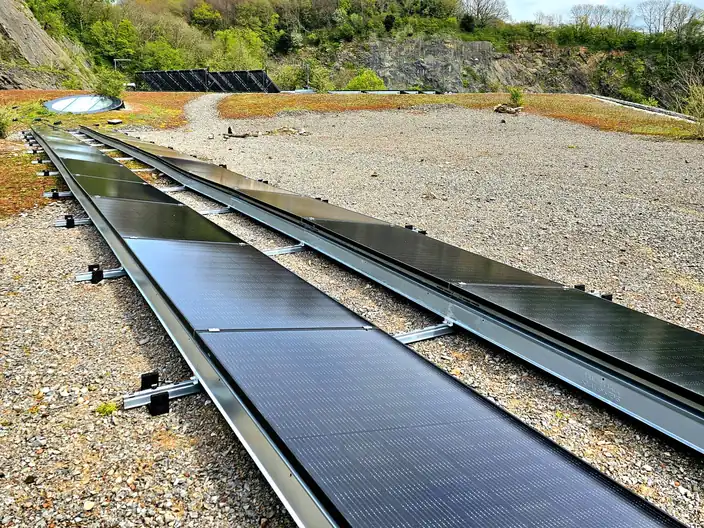
The usual triggers:
- The roof has 10 years left in it and the panels are meant to last 25, so you’d be paying to lift them off and refit them halfway through.
- It’s asbestos-cement or other fragile sheeting. Panels can still go on, but the access, the sheet work and the safety controls all cost money.
- The roof is simply too small for the load. Cold stores, process lines and electric fleets can use more than any roof will make.
- You lease the building and the landlord won’t agree to anything fixed to the roof. Some never do.
- The building is listed. Ancoats and Castlefield are full of them, and a canopy in the yard can be easier to get approved than panels on the mill.
If any of those apply and you have parking or spare land, our pages on solar carports for business car parks and ground-mounted solar on spare land explain how each is built. The rest of this guide covers the decision before you get there.
How much car park or land you actually need
Space is the first thing to check, because it limits everything else. The sums are simpler than most people expect.
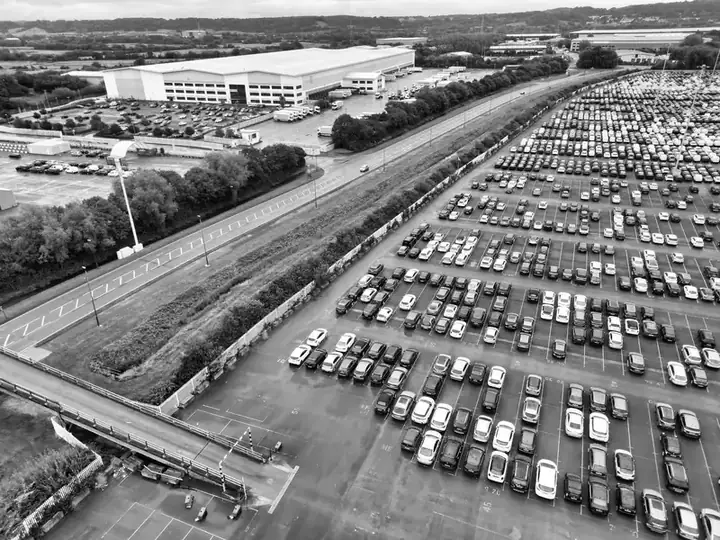
Carports, bay by bay
A standard UK parking bay is about 2.4 metres wide and 4.8 metres deep, so roughly 11.5 square metres. Modern panels produce a little over 200 watts per square metre, which works out at about 2.5kWp a bay once the canopy is laid out. At the shallow tilt a canopy uses, the European Commission’s PVGIS solar calculator gives about 813kWh per kWp a year for Trafford Park. That’s roughly 2,000kWh a bay.
So a row of 20 bays carries a canopy of around 50kWp, making something like 40,000kWh a year. A 60-bay staff car park gets you to about 150kWp, which is a decent rooftop-sized system without touching the building.
Ground arrays, by the hectare
Ground arrays need room between the rows so one doesn’t shade the next, and space for fencing and a track. As a rough yardstick, Salford’s council-run solar farm at Little Hulton puts 2MW on 3.8 hectares, so a little under 2 hectares per megawatt. On that ratio a 100kWp array needs about 0.2 hectares, or half an acre. Steeper tilts need wider gaps between rows, so the exact figure depends on the design.
Pairing a carport with workplace EV charging
This is where carports earn their keep. The panels sit directly above the cars that need charging, and the cars are parked there during the hours the panels produce most.
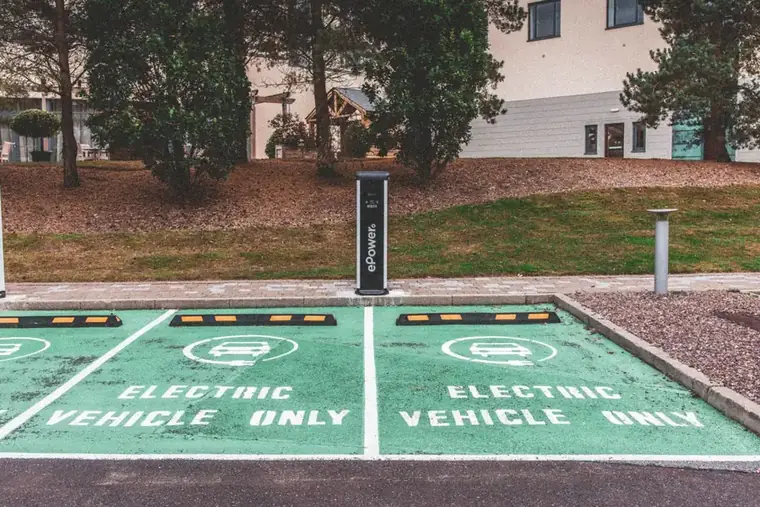
The sums show why. An electric car typically covers 3 to 4 miles per kWh, so the 2,000kWh a canopy bay makes in a year is worth roughly 7,000 miles of driving. That’s for the year, though. PVGIS gives June about 116kWh per kWp at a shallow tilt and December about 16. In summer a bay can run a commuter’s car; in December it covers a small fraction of it. The grid, or a battery, fills the gap.
The money side changed in 2026. Under the government’s Workplace Charging Scheme changes from April 2026, businesses can get up to £500 per socket for installations completed from 1 April 2026, up from £350. The limit is 40 sockets across all your sites and the funding runs to 31 March 2027. Ten sockets under a canopy could bring in up to £5,000 towards the chargers.
Tax relief helps too. Spending on charge points qualifies for a 100% first-year allowance, which the HMRC policy paper on extending first-year allowances for chargepoints confirms runs to 31 March 2027 for Corporation Tax. The canopy and panels are treated differently from the chargers, so get your accountant to split the two in the plan.
One thing to watch: a dozen chargers can push a site past its agreed import capacity on a dark winter afternoon. Load management, and possibly a battery, are part of the design, not extras.
What goes into the ground: foundations, trenches and buried services
A rooftop job is mostly about the roof. A carport or ground array is closer to a small civil engineering job, and the ground decides a lot of the price.
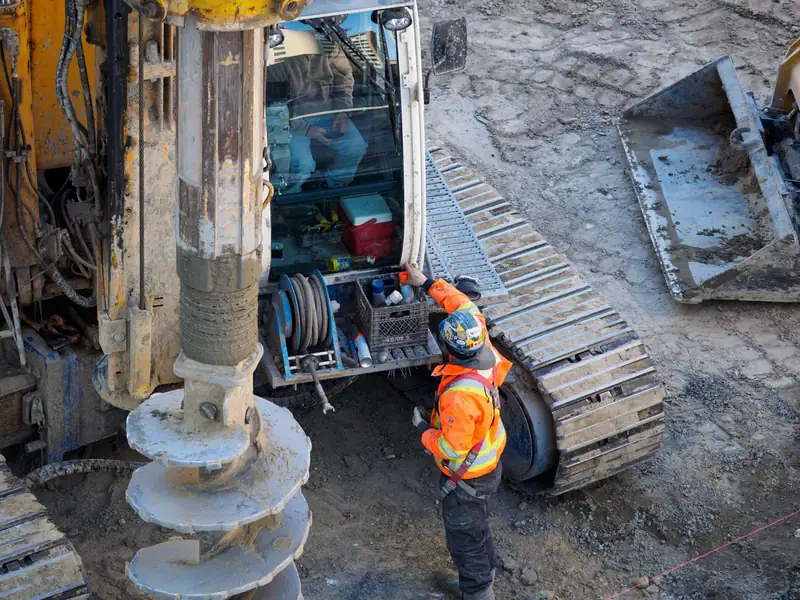
Under a car park
A carport column has to resist wind trying to lift the whole canopy, not just the weight pressing down. That usually means reinforced concrete pads or bored piles at each column, sized by a structural engineer. Before anyone digs, the car park needs a utility scan. Drainage runs, lighting cables, water mains and gas pipes are often under the bays, and the drawings for an older site may not show them all. Once the bases are in, the tarmac has to be reinstated and the canopy’s rainwater taken into a drain rather than across a footpath.
Under a field
Ground arrays are lighter. The frames are usually driven steel piles or ground screws, and a pull-out test tells the designer how deep they need to go. Soft ground on the mosslands west of Manchester can mean longer piles. Capped landfill and some made ground can’t be pierced at all, so concrete ballast blocks are used instead.
The trench back to the meter
The cable often costs more than people expect. A canopy at the far end of a car park, or an array in a field 200 metres from the building, needs an armoured cable in a trench back to your switchroom. Longer runs mean thicker cable to keep losses down. Crossing a yard, a farm track or a road that has to stay open adds traffic management and reinstatement.
Planning in Greater Manchester: canopies, fields and the green belt
The two options sit in very different places in planning law. We’ve covered the detail in our guide to planning permission for commercial solar in Greater Manchester, so this is the short version.
Car-park canopies have their own permitted development right, Class OA, since December 2023. It needs prior approval from the council, the canopy can’t be more than 4 metres high, and it must be at least 10 metres from the curtilage of any house or flat. Car parks that back onto terraced streets in Bolton, Leigh or Eccles can fail that last test. In that case it becomes a full application.
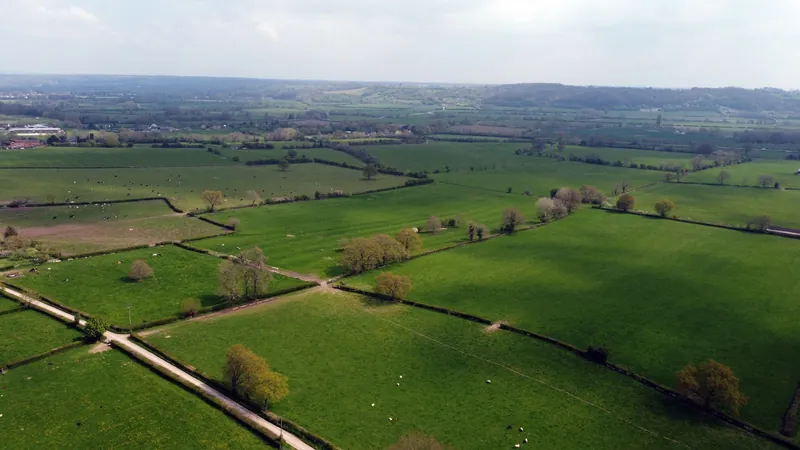
Ground arrays of any useful size almost always need full planning permission. The bigger issue around Greater Manchester is the green belt. A lot of the open land between the towns, including much of the countryside on the Wigan and Bolton fringes and the Mersey valley between Sale and Didsbury, is green belt. National policy says many parts of renewable energy schemes there are inappropriate development, so you have to show very special circumstances. The wider benefits of renewable power can count towards that, and solar schemes have been approved on that basis, but it’s a harder case to make. Check the designation on your council’s local plan map before paying for a layout.
Glare is another local factor. A site under the approach to Manchester Airport, or next to a busy road, will face more questions about reflections, and a canopy roof faces up at whatever flies over it.
Where the money goes on a carport or ground array
The government’s cost data for solar stops at 50kWp and doesn’t separate carports or ground mounts from roofs. For 2025/26 it puts 10-50kW installations in the North West at a mean of £1,248 per kW. That’s mostly rooftop work, so treat it as the floor, not the price.
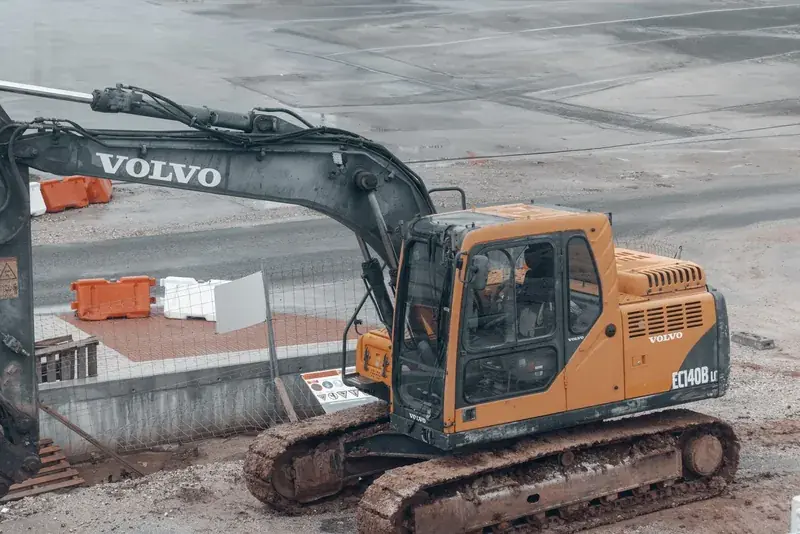
On top of the panels, inverters and electrical work, a carport adds:
- Structural steel, which grows with span and clear height
- Foundations, sized from the engineer’s calculations and the ground
- Breaking out and reinstating tarmac, kerbs and bay markings
- Gutters, downpipes and connections into drainage
- Chargers, their cabling and any load management system
- Phasing the work so most of the car park stays open
A ground array swaps the heavy steel for lighter frames, but adds fencing, a planning application with any reports the council wants, and usually a longer cable trench. We don’t publish a per-kWp figure for either because those items move it too much. Ask any installer to price them as separate lines, so you can see which part of the job is driving the total.
Payback: what moves the numbers
The saving works the same way as on a roof: every unit you make and use yourself is a unit you don’t buy. What changes is how much each option makes and how much of it you use.

Take a 50kWp canopy making about 40,650kWh a year. If 85% of that is used on site at 27p per kWh, the saving is around £9,300 a year. DESNZ’s 2025 averages for business electricity ran from 25.9p to 34.9p per kWh depending on how much you use, so your own rate could push that either way. The same 50kWp on a south-facing ground frame at 40° would make about 44,800kWh, roughly a tenth more, and nearly all of the extra arrives between October and April, when a shallow canopy struggles.
These are the factors that move payback most:
- How much you use on site. A weekday-only business spills power every weekend. Chargers and a battery both raise the share you keep.
- Your marginal unit rate, which matters more than the average printed on the bill.
- Scale. Mobilising a crane, a utility scan and a structural design costs much the same for 20 bays as for 60, so the bigger canopy usually pays back sooner.
- Tax and grants. Chargers get the 100% allowance and the workplace grant. Solar panels are special-rate plant, covered by the 50% first-year allowance or the £1 million Annual Investment Allowance.
- Export terms. If the network offer caps export, surplus power is wasted unless you store it. Our guide to grid connection, G99 and export limits in Manchester explains how those caps are set.
Our honest view: a carport will rarely beat a sound, south-facing shed roof on payback alone. It earns its place when the roof is out of the running, or when the chargers were going in anyway. A ground array usually lands between the two, and the trench and the planning decide where.
Frequently asked questions
Is a solar carport more expensive than rooftop solar?
Per kWp, yes. The panels and inverters cost the same, but a carport also needs steel columns and beams, foundations dug into the car park, drainage and tarmac reinstatement. A ground array sits in between, with lighter frames but often a long cable trench. There's no official cost dataset for either, so the only reliable figure is a priced quote after a survey.
How many parking bays does a solar carport need to be worthwhile?
Each standard bay of about 2.4 by 4.8 metres can carry roughly 2.5kWp of modern panels under a canopy. At a shallow tilt in Manchester that makes around 2,000kWh a year per bay, using PVGIS figures. Twenty bays gives a canopy of about 50kWp and around 40,000kWh a year, which is enough to matter on most business bills.
Can we get a grant for EV chargers under a solar canopy?
Possibly. The government's Workplace Charging Scheme pays up to £500 per socket for installations completed from 1 April 2026, for up to 40 sockets across your sites, and runs until 31 March 2027. Separately, companies can claim a 100% first-year capital allowance on charge point spending until 31 March 2027. The canopy and panels themselves aren't covered by the charging grant.
Will the council approve a ground-mounted solar array in the green belt?
It can, but it's harder. National planning policy treats many parts of renewable energy schemes in the green belt as inappropriate development, so you have to show very special circumstances. The wider environmental benefit of the extra renewable power can count towards that. Much of the open land around the edge of Greater Manchester is green belt, so check the designation before spending money on a design.
Thinking about solar or a battery for your site?
Send us a year of half-hourly data and we'll tell you, in writing, what size of system makes sense and roughly what it would save. Manchester, Salford, Trafford, Bolton, Wigan and in between.