
28 October 2026
Commercial Solar For Offices, Schools And Care Homes In Greater Manchester
Commercial solar for offices, schools and care homes in Greater Manchester: load profiles, batteries, roofs, safeguarding on site and how each sector pays.
Offices, schools and care homes all look like easy wins for commercial solar in Greater Manchester. They have decent roofs, bills that never stop and boards or governors who want something visible to show for their carbon plans. Where they part company is the clock. A south-facing array here makes roughly 820 to 900 kWh a year for every kW installed. An office draws most of its power between eight and six on weekdays. Pupils are in school for 190 days a year, and the six-week summer break falls in the sunniest stretch of it. A care home never switches off at all. Those patterns decide how much of the output each building actually uses, and that decides the payback. Government money has also arrived for one of the three: by July 2026, 245 schools and colleges had panels funded through Great British Energy. Below, each sector in turn: demand, batteries, roofs, working on an occupied site and paying for it.
Commercial solar for offices, schools and care homes: it all comes down to timing
Every kWh your panels make has two possible values. Used on site, it’s worth whatever you’d otherwise pay your supplier for that unit. Sent out to the grid, it earns an export rate that is usually a fraction of that, if you can get one at all.
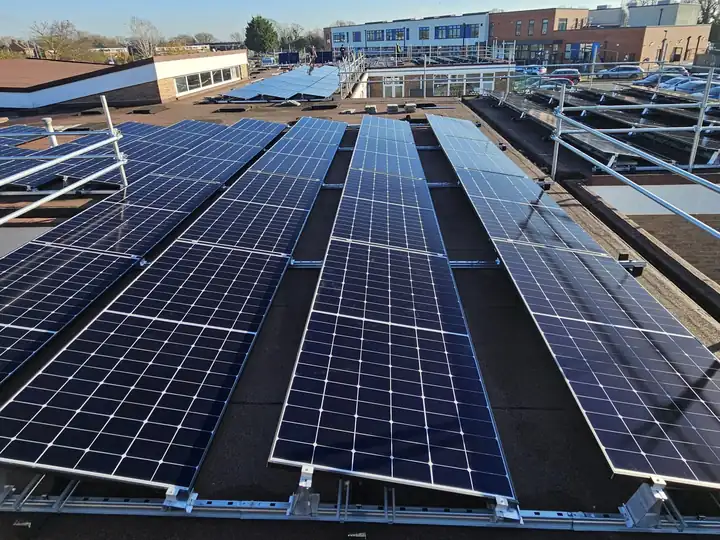
So the question for any of these buildings isn’t “how many panels will fit?” It’s “when do we use electricity, and how closely does that match the sun?” Half-hourly meter data answers it. Most offices, larger schools and care homes of any size already have it, through their supplier or a council or trust energy team. Overlay a generation curve for your roof and the share of solar you’d consume becomes a number rather than a guess.
That comparison is the first thing we do on any commercial solar panel installation, and the three sectors here give three very different answers.
Offices: a weekday load that follows the sun
An office is busiest exactly when panels are at their best. Lighting, computers, kitchens and lifts run from early morning to early evening, and comfort cooling climbs on bright afternoons, which is when a roof array peaks. Server and comms rooms add a small load that never stops.

Weekends are the weak spot. Most offices sit close to empty on Saturday and Sunday, so generation over those two days goes to export unless the array is modest enough that the base load (servers, fridges, standby) swallows it. Hybrid working has thinned out Mondays and Fridays in plenty of offices too, which is worth checking in your own data rather than assuming the building is full five days a week.
Multi-let blocks add a wrinkle. In most of them the landlord holds a supply that runs the common parts, lifts and central heating and cooling plant, while each tenant has its own meter. Solar normally connects to the landlord’s supply, because that’s where the steady daytime load sits and it avoids selling electricity to tenants. Feeding tenants directly is possible but needs its own contract, so settle early whose bill the panels are meant to cut.
Schools: strong term-time demand and a summer gap
During term a school is a good solar match. Classrooms, ICT suites, kitchens, sports halls and heating pumps all run through the school day, and the building is close to empty by early evening. The trouble is the calendar.

With pupils in for 190 days, more than 170 days a year have no lessons, counting weekends. The biggest single block is the summer holiday, which across Greater Manchester’s ten boroughs usually runs from late July into the first days of September. June to August are the strongest months for generation, so a school sized to fill its roof can end up exporting a big slice of its year’s output while the buildings stand quiet.
There are ways to narrow that gap. Holiday clubs, sports lettings and summer building works all use power, and site staff are in through most of the break. The bigger lever is sizing. A smaller array that the school consumes almost entirely in term often pays back better than a larger one with a long export tail. Secondary schools, with more floor area, longer days and heavier ICT and catering use, can usually justify a bigger system than a primary on the same size of roof.
Care homes: round-the-clock demand, hot water and laundry
A care home is the one building of the three that uses solar seven days a week. Residents live there, so lighting, call systems, lifts, kitchens and pressure-relief mattresses run around the clock. Weekends look much like weekdays, and there’s no summer shutdown.

Two loads stand out. Laundry runs for much of the day, with industrial washers and dryers working through bedding and clothing for every resident. Hot water is the other. It has to be stored at 60°C or above to control legionella, then blended down at the tap so residents can’t be scalded, which means a lot of heating energy every day.
Before counting on solar for either, though, check what fuel they use. In many homes the boilers, water heaters and tumble dryers run on gas, and an electric array does nothing for them. Where hot water comes from an immersion heater, a heat pump or electric calorifiers, solar can feed it directly, and that’s one of the strongest self-consumption cases there is. If the boilers are due for replacement anyway, it’s worth looking at the heating and the solar together.
Where battery storage fits in each sector
A battery earns money by moving cheap or free energy into expensive hours. On SP Electricity North West’s network, the expensive window is 4pm to 7pm on weekdays, so the useful question for each sector is how much it uses then, and whether there’s daytime surplus to fill a battery.

Offices are the weakest fit. A well-sized office array rarely leaves much spare on weekdays, and the building empties around the start of the expensive window. A small battery can trim the last hour or two of the working day, but the numbers are often thin.
Schools sit in the middle. A battery can carry afternoon surplus into after-school clubs and evening lettings, and it’ll cycle usefully through term. What it can’t do is bridge six weeks of summer. Size it to a day’s swing, not to the holidays.
Care homes are usually the strongest case. Demand stays high through the evening and overnight, the weekday red band hits a building that’s still fully occupied, and solar surplus around midday has somewhere to go. Backup is a separate design question: it needs islanding equipment, and it supplements rather than replaces the generator and emergency lighting your fire strategy depends on. Our commercial battery storage page covers the hardware, and the article on whether a battery is worth it for a Manchester business goes through the tariff arithmetic.
Flat-roofed schools, office blocks and converted villas: roofs and structural surveys
The roof can make or break the project in all three sectors, and each tends to bring its own type.
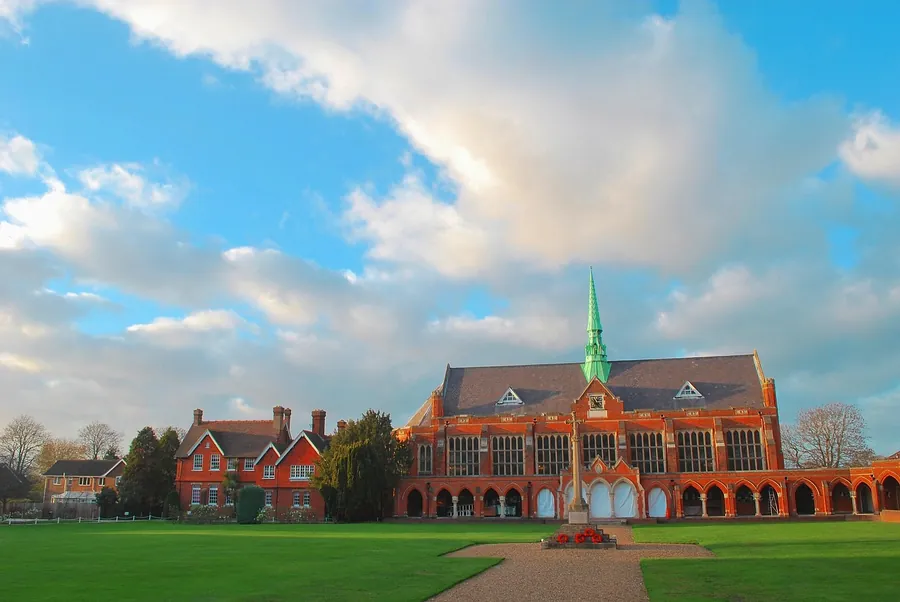
Schools
Plenty of Greater Manchester schools have a 1960s or 1970s block with a felt or asphalt flat roof, often on a lightweight or system-built frame with little spare capacity. Some of those roofs are close to the end of their life, and it rarely makes sense to put 25 years of panels on a covering that might last ten. Two checks come before any design. The first is RAAC, the aerated concrete planking used mainly in flat roofs from the 1950s to the mid-1990s, which the DfE has asked every school’s responsible body to check for. The second is asbestos, which may be present in any school built before 2000. Older board schools with slate pitched roofs are a different job again, closer to a heritage install.
Office blocks
A concrete-framed office roof is often strong enough, but it’s crowded. Chillers, lift motor rooms, extract fans, window-cleaning cradle tracks and sometimes a mobile phone mast let to an operator all claim space. Age alone isn’t a barrier, mind: Manchester’s 1962 CIS Tower had more than 7,000 solar panels fitted to its service tower in the mid-2000s.
Care homes
Plenty of homes in areas such as Didsbury, Whalley Range or Bowdon are converted Victorian or Edwardian houses with slate roofs, chimneys and dormers, often inside a conservation area. Purpose-built homes tend to have hipped tiled roofs facing several ways, which splits an array east and west, plus flat-roofed extensions that can carry ballasted frames.
Whatever the type, a structural engineer should check the frame, the covering and wind uplift before anything is ordered. Ballasted frames avoid drilling through a flat roof’s membrane but add a lot of weight, while fixed frames are lighter and need properly sealed penetrations. Our roof check for commercial solar covers loading and surveys in detail.
Working on an occupied school or care home site
Neither a school nor a care home can hand the building over for a fortnight and move everyone out. The install has to fit around the people inside, and that takes as much planning as the panel layout.

In schools, safeguarding comes first. The Department for Education’s Keeping children safe in education statutory guidance puts the decision about contractor checks on the school: anyone in regular contact with pupils needs an enhanced DBS check, and nobody unchecked should ever work unsupervised. In practice a good installer works so that contact never happens. Expect identity checks at reception, a fenced scaffold and compound away from playgrounds and drop-off routes, materials lifted outside the school day and as much roof work as possible during the holidays. The summer gap that hurts self-consumption makes the ideal install window.
Care homes raise different problems. Residents may be living with dementia, so noise, strangers and changes to routine all matter. Agree working hours with the manager, keep fire exits and evacuation routes clear, and plan any hot works around the fire alarm. The trickiest moment is the electrical tie-in, which needs a short shutdown. Nurse call, lifts, kitchen equipment and anything medical have to stay powered, so plan a generator or temporary supply before the date is fixed.
Offices are simpler, though weekends are often booked for crane lifts and roof access past tenants. Industrial sites have their own hazards, from forklifts to loading docks, which our guide to solar for warehouses and factories in Greater Manchester deals with.
Paying for commercial solar in Greater Manchester schools, offices and care homes
How the money comes together varies more between these three sectors than anything else in this guide.

Schools: government schemes and frameworks
The government has put real money into school solar. In its July 2026 announcement on the Great British Energy Solar Partnership, the DfE said 245 schools and colleges already had government-funded panels and 100 more would join, backed by up to £40 million. The first wave favoured deprived areas of the North East, West Midlands and North West. A separate pilot, in which private investors fund, own and maintain panels while schools buy the power at no upfront cost, covers 150 schools in Yorkshire and the Humber, the East Midlands and the South East, so not Greater Manchester. A national rollout is expected from 2027-28.
Places are limited, and none of this sets out an open application route, so most schools will still pay their own way. The DfE’s Get help buying for schools solar PV buying option lists a supply-and-installation framework for single schools and trust-wide programmes, which saves running a full tender. Ownership needs settling before any of that: a community school’s roof usually belongs to the council, a voluntary aided school’s to its diocese or trustees, and an academy normally holds its site on a long lease, so the right consent has to be in place. One more point for academies and charity-run homes is that installing solar and batteries in a building used solely for a relevant charitable purpose is zero-rated for VAT until 31 March 2027. Whether your building qualifies is a question for your accountant.
Offices and care homes: buying or financing
Private operators choose between cash, asset finance, a lease or a power purchase agreement, and each one treats tax and ownership differently. Our guide to buying, leasing or using a PPA sets them side by side. For care groups with several homes, a PPA across the estate can be easier to approve than separate capital bids.
Planning, grid connection and payback
Most flat and pitched roofs fall under permitted development, though conservation areas and anything over 50kW need more care, as our planning guide for Greater Manchester explains. Larger systems also need a G99 application to the network operator, which often sets the timetable; see our G99 and grid connection guide.
On payback, the worked example in our commercial solar cost guide comes out at a little over five years, but only where every unit replaces grid power. A care home using nearly all its output will sit closer to that. An office loses its weekends and a school loses its holidays, so their payback stretches unless the array is sized to the building. We won’t quote a sector payback without your meter data, because the share you use on site moves the answer more than the panel price does.
If you run an office, school or care home anywhere in Greater Manchester, send us your half-hourly data and book a site survey.
Frequently asked questions
Is solar worth it for a school that shuts for the summer holidays?
Often yes, provided the array is sized to term-time demand rather than to the roof. Pupils are in for 190 days a year, and the long summer break lands in the brightest weeks, so a smaller system that the school uses almost entirely during term usually pays back better than a big one that exports half its output in August. Holiday clubs, lettings and summer building works all soak up some of the gap.
Do solar installers working at a school need DBS checks?
It depends on the contact they'll have with pupils, and the school decides. Under the Department for Education's Keeping children safe in education guidance, contractors in regular contact with children need an enhanced DBS check, and anyone the school hasn't checked must never be left to work unsupervised. Most roof installs are planned so the crew never shares space with pupils, and many happen in the holidays.
Can a care home keep running on solar and batteries during a power cut?
Only if the system is designed for it. A standard grid-tied setup shuts down when the grid fails, so backup needs a battery inverter and changeover equipment built to island part of the building, sized for the circuits you choose. It shouldn't replace the generator, emergency lighting or other arrangements your fire risk assessment and insurer already rely on.
Can a Greater Manchester school get free solar panels from Great British Energy?
Some have. The first wave of the Great British Energy Solar Partnership targeted schools in deprived areas of the North East, West Midlands and North West, and by July 2026 the government said 245 schools and colleges had funded panels, with 100 more to follow. Places are limited and the announcements don't describe an open application route, so most schools still fund solar through their own budgets, trust capital or a DfE-listed framework.
Thinking about solar or a battery for your site?
Send us a year of half-hourly data and we'll tell you, in writing, what size of system makes sense and roughly what it would save. Manchester, Salford, Trafford, Bolton, Wigan and in between.